
GHK-Cu: identity, research literature, and verified purity
99.959%assayed by HPLC at Janoshik
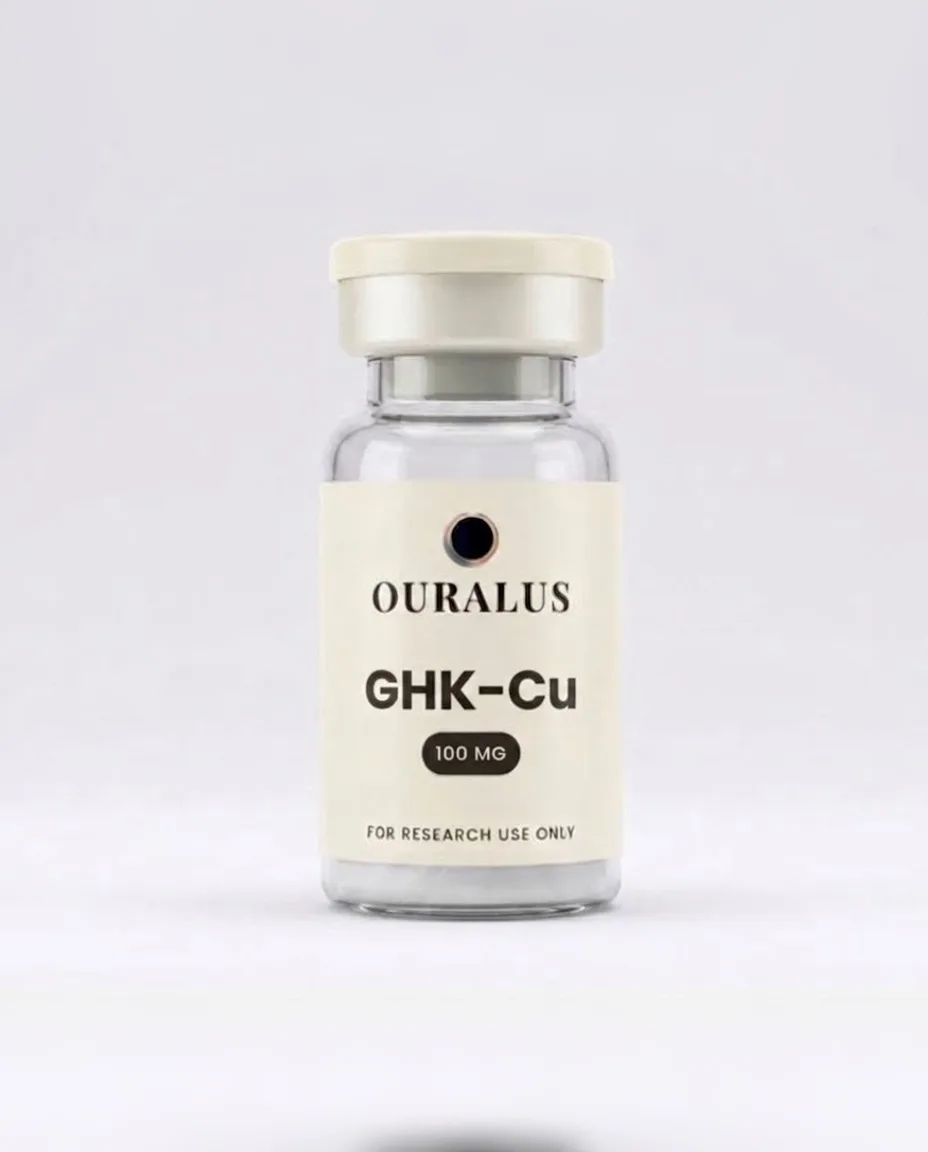
GHK-Cu is a copper(II) complex of the tripeptide glycyl-L-histidyl-L-lysine (Gly-His-Lys), CAS 89030-95-5. Ouralus supplies it as a lyophilized powder for laboratory research use only. The lot currently shipping assayed 99.959% by third-party HPLC at Janoshik, and that certificate is published here with a key you can confirm with the laboratory yourself.
Identity and registry data
- CAS
- 89030-95-5
- Molecular formula
- C14H22CuN6O4
- Molar mass
- 401.91 g/mol
- Sequence
- Gly-His-Lys
- PubChem CID
- 71587328
- UNII
- 6BJQ43T1I9
Also known asCopper tripeptide-1 · Copper peptide GHK-Cu · Prezatide copper · Copper(II)-GHK
What the research literature covers
The characterization below reflects published research literature only. It describes what that literature examines; it is not a statement about use in people. GHK-Cu is investigational research material and is not an approved product.
GHK-Cu is a copper(II) complex of the tripeptide glycyl-L-histidyl-L-lysine (Gly-His-Lys), supplied as a lyophilized powder for laboratory research use only.
In the literature the tripeptide is studied for its copper-binding chemistry and its role in extracellular-matrix and tissue-remodelling research models; the copper ion is coordinated by the peptide backbone and the histidine side chain.
Reported mechanism · literatureDescribed in the research literature as a copper-coordinating tripeptide examined in extracellular-matrix and cytoprotection models; the summary reflects that literature only.
- Extracellular matrix
- Tissue repair models
- Cytoprotection
- Angiogenesis
GHK-Cu and BPC-157, side by side
These two are frequently discussed together. They are different molecules, with different sequences and different molar masses. The table states what each one is and what its current lot assayed. It does not say which is preferable for any purpose, and nothing on this site does.
| Property | GHK-Cu | BPC-157 |
|---|---|---|
| What it is | Copper(II) complex of a synthetic 3–amino-acid peptide (tripeptide) | Synthetic 15–amino-acid peptide (pentadecapeptide) |
| Sequence | Gly-His-Lys | Gly-Glu-Pro-Pro-Pro-Gly-Lys-Pro-Ala-Asp-Asp-Ala-Gly-Leu-Val |
| CAS | 89030-95-5 | 137525-51-0 |
| Molar mass | 401.91 g/mol | 1419.5 g/mol |
| Research areas in the literature | Extracellular matrix, Tissue repair models, Cytoprotection, Angiogenesis | Tissue repair models, Angiogenesis, Cytoprotection, Extracellular matrix |
| Assayed purity, current lot | 99.959% | 99.497% |
| Verify key | FFU7FYYJNJ9V | RMAIPH836PXJ |
GHK-Cu and BPC-157, in full → · Full BPC-157 reference →
Also compared withTB-500
Purity, and how to check it yourself
Purity here is a measurement, not a position. The lot currently shipping was analysed by Janoshik, an independent laboratory, by HPLC for identity and assayed purity. We do not test our own material.
- Lot
- Not stated on report
- Analysed
- July 31, 2026
- Assayed purity
- 99.959%
- Testing laboratory
- Janoshik
- Verify key
- FFU7FYYJNJ9V
Enter that key at janoshik.com/verify and the laboratory returns the report it issued for this batch. You are confirming the result with them, not with us. The full certificate is published as a PDF on the GHK-Cu certificate page.
We report HPLC identity and assayed purity only. We do not run heavy-metal, microbial, endotoxin, or sterility analysis, and we do not claim it anywhere on this site.
Handling and stability
- Lyophilized
- −20°C · 24 months (sealed, desiccated)
- Reconstituted
- 2–8°C · weeks (research handling)
Reconstitution solvent: sterile water. Reconstitution parameters are a laboratory-handling matter determined by the researcher; no in-vivo or human-use parameters are provided. The concentration arithmetic for a reconstituted research solution is available in our reconstitution calculator.
Questions
What is GHK-Cu?
GHK-Cu is a copper(II) complex of the tripeptide glycyl-L-histidyl-L-lysine (Gly-His-Lys). Ouralus supplies it as a lyophilized powder for laboratory research use only, with a third-party HPLC certificate of analysis published where tested.
What is the formula of GHK-Cu?
The neutral 1:1 copper complex is commonly given as C14H22CuN6O4 (molar mass ≈ 401.9 g/mol; PubChem CID 71587328, CAS 89030-95-5). Different protonation-state representations of the same complex appear across databases.
Is GHK-Cu third-party tested?
Yes. The lot currently shipping was analysed by Janoshik, an independent laboratory, by HPLC for identity and assayed purity, and assayed 99.959%. The certificate carries verify key FFU7FYYJNJ9V, which you can confirm directly at janoshik.com/verify.
Is GHK-Cu an approved product?
No. GHK-Cu is supplied strictly as a research chemical for laboratory research use only. It is not a drug, not a supplement, and not a food, and it is not for human or animal consumption.
Questions answered from the cited research
Selected literature
- The human tri-peptide GHK and tissue remodelingPickart L · Journal of Biomaterials Science, Polymer Edition · 2008PMID 18644225 ↗
- The human tripeptide GHK-Cu in prevention of oxidative stress and degenerative conditions of agingPickart L, et al. · Oxidative Medicine and Cellular Longevity · 2012PMID 22666519 ↗
- GHK Peptide as a Natural Modulator of Multiple Cellular Pathways in Skin RegenerationPickart L, Vasquez-Soltero JM, Margolina A · BioMed Research International · 2015PMID 26236730 ↗
- Regenerative and Protective Actions of the GHK-Cu Peptide in the Light of the New Gene DataPickart L, et al. · International Journal of Molecular Sciences · 2018PMID 29986520 ↗
- Glycyl-L-histidyl-L-lysine-Cu2+ attenuates cigarette smoke-induced pulmonary emphysema and inflammation by reducing oxidative stress pathwayZhang Q, et al. · Frontiers in Molecular Biosciences · 2022PMID 35936787 ↗
- Synergy of GHK-Cu and hyaluronic acid on collagen IV upregulation via fibroblast and ex-vivo skin testsJiang F, et al. · Journal of Cosmetic Dermatology · 2023PMID 37062921 ↗
- The glycyl-l-histidyl-l-lysine-Cu2+ tripeptide complex attenuates lung inflammation and fibrosis in silicosis by targeting peroxiredoxin 6Bian Y, et al. · Redox Biology · 2024PMID 38879894 ↗
- Copper Complexes with New Glycyl-l-histidyl-l-lysine-Hyaluronan Conjugates Show Antioxidant Properties and Osteogenic and Angiogenic Synergistic EffectsGreco V, et al. · Bioconjugate Chemistry · 2025PMID 40123442 ↗
Research-literature characterization, provided for research context only. For laboratory research use only. Not for human consumption.