MOTS-c: compound identifiers, research literature, and verified purity
99.274%assayed by HPLC at Janoshik
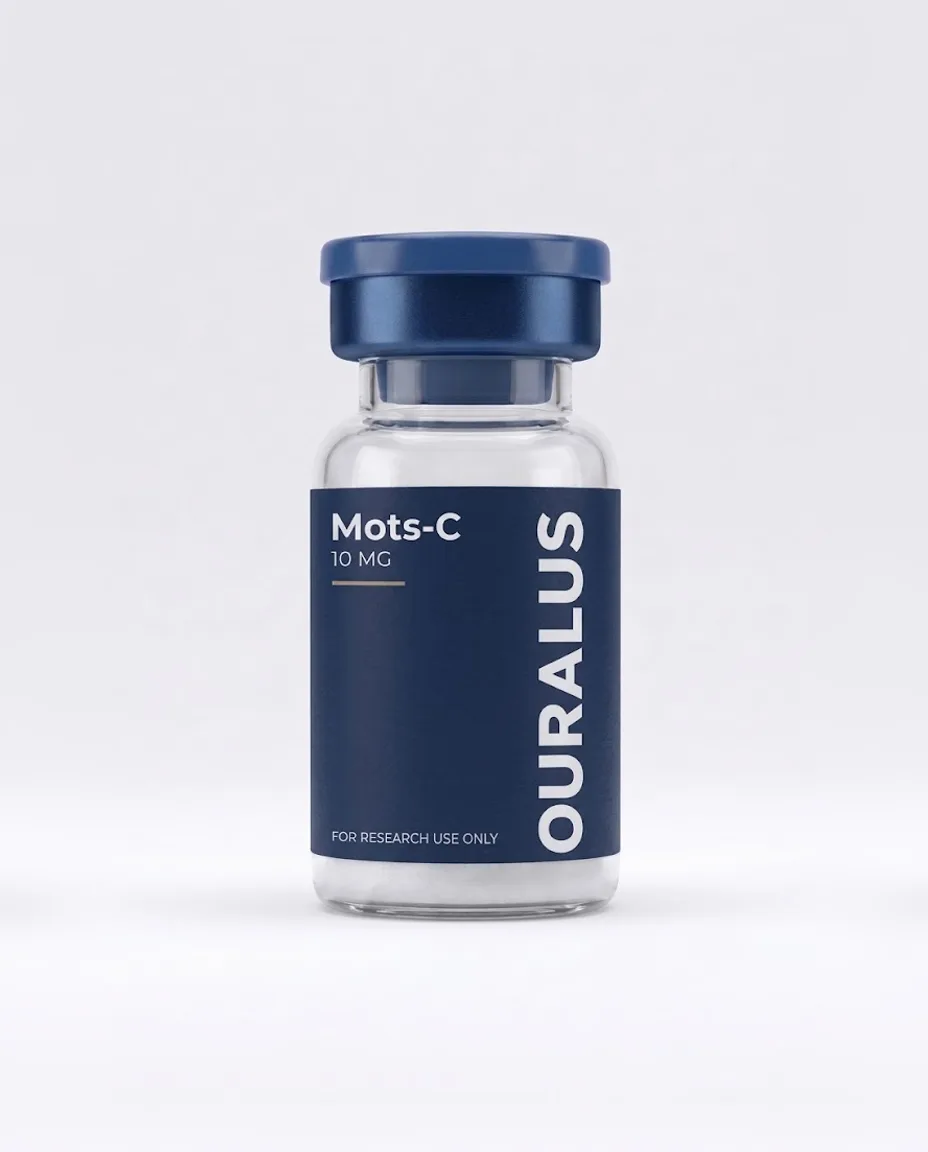
The Janoshik report assayed 99.274% by third-party HPLC, and that report is published here with a key you can confirm with the laboratory yourself.
Compound identifiers
- CAS
- 1627580-64-6
- Molecular formula
- C101H152N28O22S2
- Molar mass
- 2174.6 g/mol
- Sequence
- Met-Arg-Trp-Gln-Glu-Met-Gly-Tyr-Ile-Phe-Tyr-Pro-Arg-Lys-Leu-Arg
- PubChem CID
- 146675088
- UNII
- A5CV6JFB78
Also known asMitochondrial-derived peptide MOTS-c · Mitochondrial ORF of the 12S rRNA type-c
What the research literature covers
The characterization below reflects published research literature only. It describes what that literature examines; it is not a statement about use in people. MOTS-c is investigational research material and is not an approved product.
MOTS-c is a 16–amino-acid mitochondrial-derived peptide (sequence MRWQEMGYIFYPRKLR) encoded within the mitochondrial 12S rRNA region, supplied as a lyophilized powder for laboratory research use only.
It is studied in the research literature in the context of mitochondrial biology and metabolic signalling; the characterization here reflects that research literature only.
Reported mechanism · literatureDescribed in the literature as a mitochondrial-derived peptide examined in metabolic-signalling and mitochondrial-biology research models; the summary reflects that literature only.
- Mitochondrial biology
- Metabolic signalling
MOTS-c and NAD +, side by side
These two are frequently discussed together. They are different molecules, with different sequences and different molar masses. The table states what each one is and what its latest published report assayed. It does not say which is preferable for any purpose, and nothing on this site does.
| Property | MOTS-c | NAD + |
|---|---|---|
| What it is | Synthetic 16–amino-acid peptide (hexadecapeptide) | Dinucleotide redox coenzyme — not a peptide |
| CAS | 1627580-64-6 | 53-84-9 |
| Molar mass | 2174.6 g/mol | 663.43 g/mol |
| Research areas in the literature | Mitochondrial biology, Metabolic signalling | Mitochondrial biology, Metabolic signalling, Cellular senescence |
| Verify key | X9QFDRJ85UYG | VC63IEZ7H6YF |
Purity, and how to check it yourself
Purity here is a measurement, not a position. A report from Janoshik, an independent laboratory, is published for MOTS-c: assayed purity and net content. We do not test our own material.
- Lot
- white cap
- Analysed
- March 25, 2026
- Assayed purity
- 99.274%
- Testing laboratory
- Janoshik
- Verify key
- X9QFDRJ85UYG
Enter that key at janoshik.com/verify and the laboratory returns the report it issued for this batch. You are confirming the result with them, not with us. The full certificate is published as a report image on the MOTS-c certificate page.
We report assayed purity and net content only. We do not run heavy-metal, microbial, endotoxin, or sterility analysis, and we do not claim it anywhere on this site.
Handling and stability
- Lyophilized
- −20°C · 24 months (sealed, desiccated)
Questions
What is MOTS-c?
MOTS-c is a 16–amino-acid mitochondrial-derived peptide encoded within the mitochondrial 12S rRNA region. Ouralus supplies it as a lyophilized powder for laboratory research use only, with a third-party HPLC certificate of analysis published where tested.
What is the sequence of MOTS-c?
The reported 16-residue sequence is MRWQEMGYIFYPRKLR (Met-Arg-Trp-Gln-Glu-Met-Gly-Tyr-Ile-Phe-Tyr-Pro-Arg-Lys-Leu-Arg), molecular formula C101H152N28O22S2 (PubChem CID 146675088, CAS 1627580-64-6).
Is MOTS-c third-party tested?
Yes. A report from Janoshik, an independent laboratory, is published for MOTS-c; it prints an assayed purity of 99.274%. Its batch field matches the lot currently shipping. The certificate carries verify key X9QFDRJ85UYG, which you can confirm directly at janoshik.com/verify.
Is MOTS-c an approved product?
No. MOTS-c is supplied strictly as a research chemical for laboratory research use only. It is not a drug, not a supplement, and not a food, and it is not for human or animal consumption.
Selected literature
- The mitochondrial-derived peptide MOTS-c promotes metabolic homeostasis and reduces obesity and insulin resistanceLee C, et al. · Cell Metabolism · 2015PMID 25738459 ↗
- A mitochondrially encoded hormone ameliorates obesity and insulin resistanceZarse K, Ristow M · Cell Metabolism · 2015PMID 25738453 ↗
- The Mitochondrial-Encoded Peptide MOTS-c Translocates to the Nucleus to Regulate Nuclear Gene Expression in Response to Metabolic StressKim KH, et al. · Cell Metabolism · 2018PMID 29983246 ↗
- MOTS-c: A Mitochondrial-Encoded Regulator of the NucleusBenayoun BA, Lee C · BioEssays · 2019PMID 31378979 ↗
Research-literature characterization, provided for research context only. For laboratory research use only. Not for human consumption.