
Glutathione: identity and research literature
No certificateidentity and purity unconfirmed
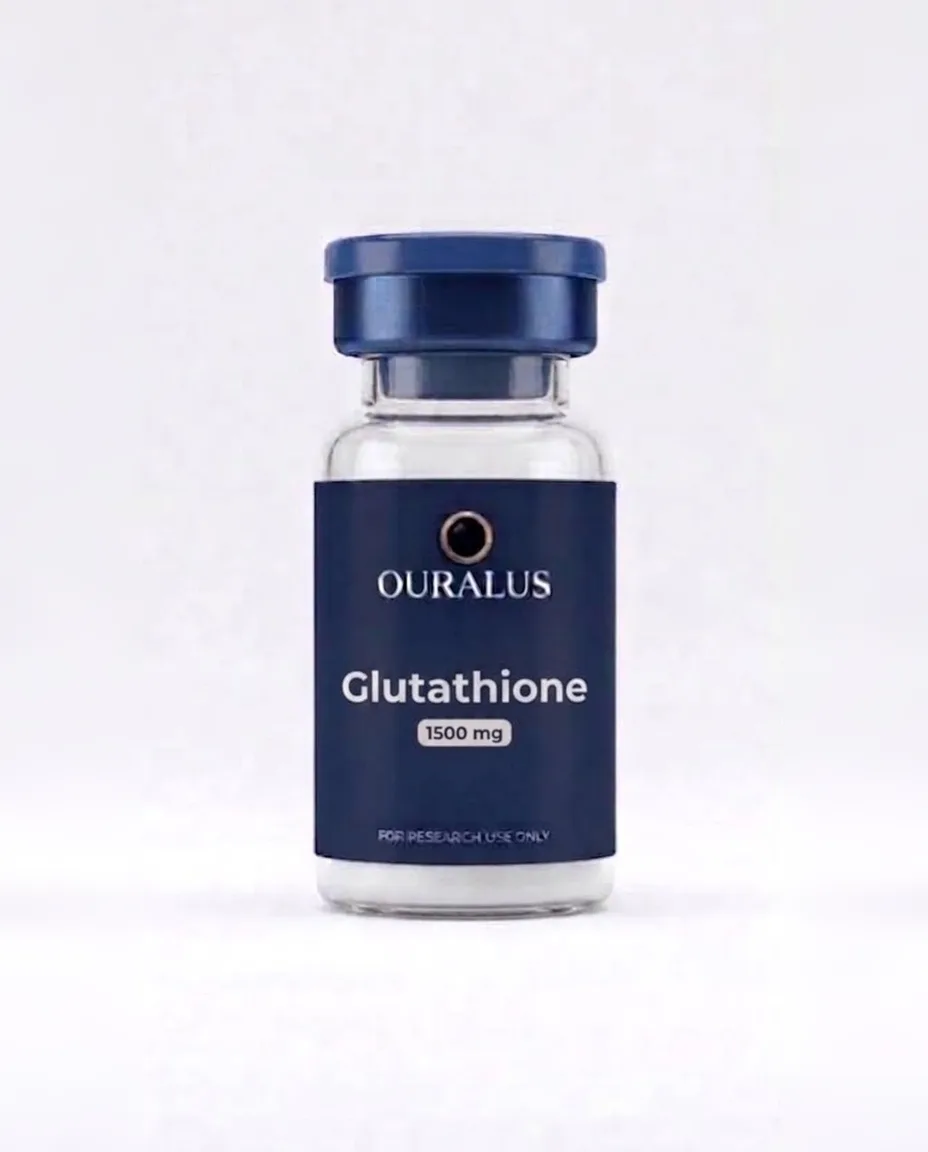
No third-party certificate of analysis has been published for this compound yet, so no purity figure is claimed for it and its identity and purity remain unconfirmed.
Identity and registry data
- CAS
- 70-18-8
- Molecular formula
- C10H17N3O6S
- Molar mass
- 307.33 g/mol
- Sequence
- gamma-Glu-Cys-Gly
- PubChem CID
- 124886
- UNII
- GAN16C9B8O
Also known asGSH · L-Glutathione reduced · Reduced glutathione · gamma-Glutamylcysteinylglycine
What the research literature covers
The characterization below reflects published research literature only. It describes what that literature examines; it is not a statement about use in people. Glutathione is investigational research material and is not an approved product.
Glutathione (GSH) is a tripeptide of glutamate, cysteine, and glycine, supplied as a lyophilized powder for laboratory research use only. Almost all of the literature published under its name concerns the glutathione that cells make for themselves — the endogenous pool — which is a distinct subject from the exogenous tripeptide listed here.
The endogenous pool is assembled inside the cell in two ATP-dependent steps, by glutamate-cysteine ligase and then glutathione synthetase, and is partitioned across cytosolic, mitochondrial, and nuclear compartments by specific transport rather than by free diffusion. A concentration measured in any one compartment therefore reflects synthesis, consumption, and export within that compartment.
The intact tripeptide is not generally carried across the plasma membrane. Extracellular gamma-glutamyl transpeptidase cleaves it to its constituent amino acids, which are taken up and re-assembled inside the cell, so an exogenous molecule and the intracellular pool are linked by degradation and resynthesis rather than by direct transfer.
The availability literature is correspondingly mixed and route-dependent: a single large oral load of glutathione did not raise plasma concentration in a 1992 report, while dietary glutathione was described as absorbed intact in a 1990 rat study. Findings about endogenous status do not carry over to the exogenous compound unless that step is established separately.
Reported mechanism · literatureIn biochemistry glutathione is described as the principal low-molecular-weight thiol redox couple, cycling between its reduced (GSH) and disulfide (GSSG) forms and acting as cofactor for the glutathione peroxidase and glutathione S-transferase enzyme families. That description is of the endogenous pool, and is not a statement about the exogenous compound.
- Cytoprotection
- Metabolic signalling
Purity, and why none is claimed here
Purity here is a measurement, not a position — and no measurement has been published for Glutathione. No third-party certificate of analysis exists for it yet, so this page states no assayed purity, no lot, and no verify key for it. Its identity and purity remain unconfirmed.
The standard does not change: lots are analysed by an independent laboratory by HPLC for identity and assayed purity, and the certificate is published with a key you can confirm at janoshik.com/verify yourself. We do not test our own material, and we do not claim a figure before its report exists. Those numbers appear here when a report does.
We report HPLC identity and assayed purity only. We do not run heavy-metal, microbial, endotoxin, or sterility analysis, and we do not claim it anywhere on this site.
Handling and stability
- Lyophilized
- −20°C · sealed, desiccated; protect from light
Questions
What is glutathione?
Glutathione (GSH) is a tripeptide of glutamate, cysteine, and glycine, with the gamma-linkage between glutamate and cysteine that distinguishes it from an ordinary peptide bond. Ouralus supplies it as a lyophilized powder for laboratory research use only.
Is the published glutathione literature about the exogenous compound?
Mostly it is not. The large majority of it measures the endogenous pool that cells synthesize themselves, which is governed by the two-enzyme synthesis pathway inside the cell. The intact tripeptide is not generally carried across the plasma membrane — extracellular gamma-glutamyl transpeptidase cleaves it into amino acids that are then re-imported and re-assembled. Endogenous-status findings therefore do not transfer to the exogenous compound on their own.
What is the molecular formula of glutathione?
C10H17N3O6S (molar mass ≈ 307.3 g/mol; PubChem CID 124886, CAS 70-18-8, UNII GAN16C9B8O). This is the reduced (GSH) form; the oxidized disulfide GSSG is a different molecule with roughly twice the mass.
Is Glutathione third-party tested?
Not yet. No third-party certificate of analysis has been published for Glutathione, so no purity figure is claimed for it and its identity and purity remain unconfirmed. Ouralus HPLC-tests its catalogue lots and publishes each certificate with a verify key confirmable at janoshik.com/verify as the report is finalized; this page will carry those figures once a report exists for this compound.
Is Glutathione an approved product?
No. Glutathione is supplied strictly as a research chemical for laboratory research use only. It is not a drug, not a supplement, and not a food, and it is not for human or animal consumption.
Questions answered from the cited research
Selected literature
- GlutathioneMeister A, Anderson ME · Annual Review of Biochemistry · 1983PMID 6137189 ↗
- Glutathione synthesisLu SC · Biochimica et Biophysica Acta · 2013PMID 22995213 ↗
- Glutathione: subcellular distribution and membrane transportOestreicher J, Morgan B · Biochemistry and Cell Biology · 2019PMID 30427707 ↗
- The systemic availability of oral glutathioneWitschi A, et al. · European Journal of Clinical Pharmacology · 1992PMID 1362956 ↗
- Bioavailability of dietary glutathione: effect on plasma concentrationHagen TM, et al. · American Journal of Physiology · 1990PMID 2221062 ↗
Research-literature characterization, provided for research context only. For laboratory research use only. Not for human consumption.