
TB-500: identity, research literature, and verified purity
99.402%assayed by HPLC at Janoshik
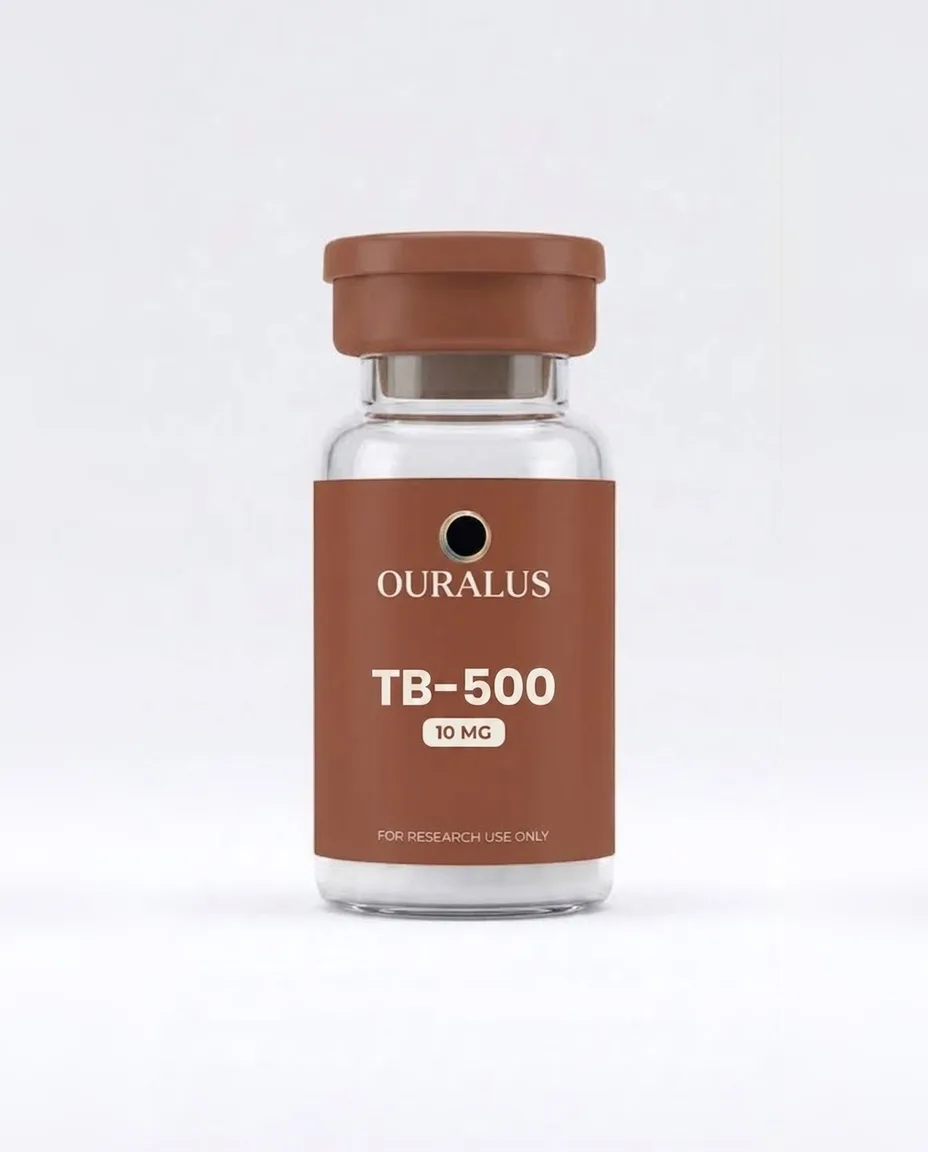
TB-500 is the common name for a synthetic, N-acetylated seven–amino-acid fragment (Ac-Leu-Lys-Lys-Thr-Glu-Thr-Gln), CAS 885340-08-9. Ouralus supplies it as a lyophilized powder for laboratory research use only. The lot currently shipping assayed 99.402% by third-party HPLC at Janoshik, and that certificate is published here with a key you can confirm with the laboratory yourself.
Identity and registry data
- CAS
- 885340-08-9
- Molecular formula
- C38H68N10O14
- Molar mass
- 889 g/mol
- Sequence
- Ac-Leu-Lys-Lys-Thr-Glu-Thr-Gln-OH
- PubChem CID
- 62707662
- UNII
- QHK6Z47GTG
Also known asTB 500 · TB500 · Ac-LKKTETQ · N-Acetyl thymosin β4 (17-23) fragment
What the research literature covers
The characterization below reflects published research literature only. It describes what that literature examines; it is not a statement about use in people. TB-500 is investigational research material and is not an approved product.
"TB-500" is the common name for a synthetic, N-acetylated peptide fragment (Ac-Leu-Lys-Lys-Thr-Glu-Thr-Gln) corresponding to an actin-binding region of thymosin beta-4, supplied as a lyophilized powder for laboratory research use only.
Material sold as "TB-500" is not always the same molecule — some suppliers provide full-length thymosin beta-4 — so identity should be confirmed against each lot's mass-spec / HPLC data. Ouralus provides a third-party certificate of analysis published where tested.
- Tissue repair models
- Extracellular matrix
TB-500 and BPC-157, side by side
These two are frequently discussed together. They are different molecules, with different sequences and different molar masses. The table states what each one is and what its current lot assayed. It does not say which is preferable for any purpose, and nothing on this site does.
| Property | TB-500 | BPC-157 |
|---|---|---|
| What it is | Synthetic N-acetylated 7–amino-acid fragment | Synthetic 15–amino-acid peptide (pentadecapeptide) |
| Sequence | Ac-Leu-Lys-Lys-Thr-Glu-Thr-Gln-OH | Gly-Glu-Pro-Pro-Pro-Gly-Lys-Pro-Ala-Asp-Asp-Ala-Gly-Leu-Val |
| CAS | 885340-08-9 | 137525-51-0 |
| Molar mass | 889 g/mol | 1419.5 g/mol |
| Research areas in the literature | Tissue repair models, Extracellular matrix | Tissue repair models, Angiogenesis, Cytoprotection, Extracellular matrix |
| Assayed purity, current lot | 99.402% | 99.497% |
| Verify key | PDXV8UJEL1G4 | RMAIPH836PXJ |
TB-500 and BPC-157, in full → · Full BPC-157 reference →
Also compared withGHK-Cu
Why the identity question matters here
Because two different molecules circulate under one name, the certificate is doing more work on this page than on most. The report published below states the identity confirmed by HPLC for the specific lot we ship, so the question of which molecule is in the vial is answered by the laboratory rather than by the label.
Purity, and how to check it yourself
Purity here is a measurement, not a position. The lot currently shipping was analysed by Janoshik, an independent laboratory, by HPLC for identity and assayed purity. We do not test our own material.
- Lot
- White
- Analysed
- December 8, 2025
- Assayed purity
- 99.402%
- Testing laboratory
- Janoshik
- Verify key
- PDXV8UJEL1G4
Enter that key at janoshik.com/verify and the laboratory returns the report it issued for this batch. You are confirming the result with them, not with us. The full certificate is published as a PDF on the TB-500 certificate page.
We report HPLC identity and assayed purity only. We do not run heavy-metal, microbial, endotoxin, or sterility analysis, and we do not claim it anywhere on this site.
Handling and stability
- Lyophilized
- −20°C · 24 months (sealed, desiccated)
- Reconstituted
- 2–8°C · weeks (research handling)
Reconstitution solvent: sterile bacteriostatic water. Reconstitution parameters are a laboratory-handling matter determined by the researcher; no in-vivo or human-use parameters are provided. The concentration arithmetic for a reconstituted research solution is available in our reconstitution calculator.
Questions
What is TB-500?
"TB-500" is the common name for a synthetic N-acetylated peptide fragment (Ac-Leu-Lys-Lys-Thr-Glu-Thr-Gln) corresponding to an actin-binding region of thymosin beta-4. Ouralus supplies it as a lyophilized powder for laboratory research use only, with a third-party HPLC certificate of analysis published where tested.
Is TB-500 the same as thymosin beta-4?
Not necessarily. The name "TB-500" is used in the market for both this short synthetic fragment and, by some suppliers, full-length thymosin beta-4. Because there is no single compendial standard tying the name to one molecule, confirm identity against the lot's certificate of analysis and mass-spec data.
Is TB-500 third-party tested?
Yes. The lot currently shipping was analysed by Janoshik, an independent laboratory, by HPLC for identity and assayed purity, and assayed 99.402%. The certificate carries verify key PDXV8UJEL1G4, which you can confirm directly at janoshik.com/verify.
Is TB-500 an approved product?
No. TB-500 is supplied strictly as a research chemical for laboratory research use only. It is not a drug, not a supplement, and not a food, and it is not for human or animal consumption.
Questions answered from the cited research
Selected literature
- Thymosin beta 4 interactionsBubb MR · Vitamins and Hormones · 2003PMID 12852258 ↗
- beta-ThymosinsHannappel E · Annals of the New York Academy of Sciences · 2007PMID 17468232 ↗
- The beta-thymosin enigmaSun HQ, et al. · Annals of the New York Academy of Sciences · 2007PMID 17495248 ↗
- Thymosin beta4 and its posttranslational modificationsHannappel E · Annals of the New York Academy of Sciences · 2010PMID 20536447 ↗
- Potential role of thymosin Beta 4 in liver fibrosisKim J, et al. · International Journal of Molecular Sciences · 2015PMID 26006229 ↗
- Thymosin Beta 4 Is a Potential Regulator of Hepatic Stellate CellsKim J, et al. · Vitamins and Hormones · 2016PMID 27450733 ↗
- Cardioprotection by Thymosin Beta 4Pipes GT, et al. · Vitamins and Hormones · 2016PMID 27450736 ↗
- Thymosin Beta-4 Modulates Cardiac Remodeling by Regulating ROCK1 Expression in Adult MammalsMaar K, et al. · International Journal of Molecular Sciences · 2025PMID 40362372 ↗
Research-literature characterization, provided for research context only. For laboratory research use only. Not for human consumption.